World cinema classics #34

[Youtube=http://www.youtube.com/watch?v=LwaPJUtZBYc&]

Tokyo Decadence (1992) – Ryu Murakami

This is a film I chose in the mid 1990s at the video store because of its cover, not being familiar at the time with the work of Murakami (Coin Locker Babies). The key scenes are four sex scenes (see more at the wiki). Three out of these heavily feature drugs. The most exquisite one, featured in the Youtube remix above, is soundtracked by Xavier Cugat music. The audio used in this particular Youtube remix is not included in the original film. I wonder what the music is. Anyone? (De temps en temps is a song (André Hornez / Paul Misraki) voiced by Josephine Baker.)

The film’s only rival in terms of my favourite film of the 1990s is the Japanese film Audition, which is also written by Murakami.

Previous “World Cinema Classics” and in the Wiki format here.

Ugly plants

Just a quick note to ask you for an image identification. I am currently “investigating” aesthetic universalism and relativism, see prev post. I came across the photo below by googling for “ugly plants”:

Moss on rocks unidentified photograph

Please help me identify the name of this moss species

Ugliness in nature is best represented by the notion of the sublime. But there are many animals and plants out there which we just plain consider ugly, without an inkling of sublimity. See for example the Komodo dragon, and this.

If you know of more pointers, please let me known.

The moss photo was probably taken at Bolivia’s  salt flat Salar de Uyuni, see this photo.

Satisfied that the photograph has been censored

Thousand cuts

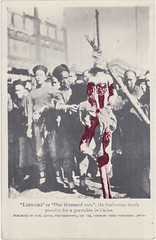
Death by a Thousand Cuts is certainly one of the most gruesome photographs in the history of visual culture. I first encountered the photo online and later when I purchased Georges Bataille’s The Tears of Eros (currently available from City Lights). The version above is from the Dutch booklet Kaarten (1967, published by Born N.V.) an excellent little study by Drs. P on his postcards with a full bibligraphy on contemporary books on collecting postcards which even mentions Ado Kyrou’s treaty of the subject, L’age d’or de la carte postale (1966) which I have in my collection.

What is particular of this postcard is its obvious censorship. And actually, for once I’m really satisfied that the photograph has been censored, because I would not like to show it to you in its original version. The notes to the postcard read “Ling-chi” or “One thousand cuts”, the barbarous death penalty for a parricide in China. Published by Karl Lewis, no. 102, Honmura Road, Yokohama, Japan.

Introducing Anton van Dalen

Anton van Dalen is a Dutch illustrator residing in the United States. He was during a period of 30 years the “secret” assistent to Saul Steinberg. His style is unique but reminds of Bracelli‘s work in the 17th century and its somewhat distanced pov feels a bit like Glen Baxter‘s absurd illustrations.

Here is a set of motor vehicle impressions via Bibliodyssey: [1] [2] [3] [4]

Bibliodyssey brought this set to my attention, if you are not already subscribing to his feed, you should. Since the demise of Il Giornale Nuovo, Bibliodyssey is the best hang-out for your daily dose of vintage visual culture.

For those of you unfamiliar with Bracelli’s work here is an example of his proto-surrealism:

From the Bizzarie di varie figure (1624) by Giovanni Battista Braccelli

From the Bizzarie di varie figure (1624) by Giovanni Battista Braccelli

Here is perhaps a better example, showcasing Bracelli cubism comparable to the one of van Dalen.

World music classics #21

[Youtube=http://youtube.com/watch?v=RBJYQMntyRg]

“Amigo” (1980) – Black Slate

I was going to give you the rarer track “Sticks Man” (robberman … why you do dat?), but it’s not on Youtube.

Notice in this clip the use of Spaghetti Western imagery, which was quite common at the time in reggae circles and exemplified by Lee Perry’s late 1960s and early 1970s output with The Upsetters.

Previous World Music Classics.