Category Archives: Uncategorized

Why read the classics?

[Amazon.com] [FR] [DE] [UK]

I finished reading Why Read the Classics? by Italo Calvino, a book featuring 36 essays on classic books.

Excellent reading. Highly erudite. Such ease of narration.

Of course, I love the genre, books about books. The last I read of its kind was Stranger Shores: Literary Essays, 1986–1999 by J. M. Coetzee[1].

Highlights, you ask?

The large essay on Stendhal and on De l’amour in particular.

That the Anabasis is a war novel.

That Twain was not much of a stylist.

That Orlando Furioso is an example of the fantastique.

A reference to the Encyclopédie des sciences inexactes by Raymond Queneau which reminded me of Umberto Eco’s pet project the Cacopedia.

And … the prose poetry of Francis Ponge:

“Kings do not touch doors. They do not know that pleasure of pushing open in front of you, slowly or brusquely, one of those big familiar rectangular panels, and turning back to close it in its place again – holding a …”
“. . . the pleasure of grabbing, at the belly of one of those tall obstacles to a room, its porcelain knob; the rapid duel in which you hold back your step for the instant it takes for the eye to open and the whole body to adapt to its new surroundings.”
“With a friendly hand you hold onto it still, before decisively pushing it back and closing yourself in another room — a feeling of enclosure which is reenforced by the click of the handle’s powerful, but well-oiled spring.”
“The Pleasures of the Door” [2]

Kant’s disinterestedness


L’indifférent (1717) by Antoine Watteau

I’ve always been baffled by Kant’s notion of disinterestedness. And then I remembered that Nietzsche was just as baffled. Here is that passage from On the Genealogy of Morality:

Kant‘s famous definition of the beautiful. “That is beautiful,” says Kant, “which pleases without interesting.” Without interesting! Compare this definition with this other one [..] by Stendhal, who once called the beautiful une promesse de bonheur. Here, at any rate, the one point which Kant makes prominent in the aesthetic position is repudiated and eliminated—le désinteressement. Who is right, Kant or Stendhal?”

… in a garret with a leaking roof

The Poor Poet (1839), a painting by Carl Spitzweg.

Look where this sufferer from artistism, this bourgeoisophobe, this starving artist, this beautiful loser, this bohemian, this tortured artist, this seeker of artistic inspiration, this man afraid of writer’s block, look at where this poor soul ends up: in a garret with a leaking roof.

How very romantic, how utterly romantic is this notion of the Artist, the creative genius touched by divine inspiration.

Only the ugly is beautiful, only the ugly is likeable

The “Pégase romantique” caricature by Jean-Gabriel Scheffer (above) depicts from left to right  Petrus BorelVictor Hugo, and Alexandre Dumas sitting on a giant crayfish. Or is that the  pet lobster Gérard Nerval supposedly took for walks in Paris on the end of a blue ribbon?

The motto of the caricature (top) reads ‘rien n’est beau que le laid; le laid seul est aimable,’ which translates as “Only the ugly is beautiful, only the ugly is likeable,” illustrating the cult of ugliness professed by for example Victor Hugo (“Le beau n’a qu’un type ; le laid en a mille“).

I found this image while researching the bouzingo, a group of minor French artists active in 1830s Paris. The source of the image is the excellent piece of grey lterature Pétrus Borel: Background, Reception and Interpretation[1] (1999) by Erik S. Bovee.

Nietzsche

Nietzsche in Basel (c. 1875), a photo of German philosopher Friedrich Nietzsche

Nietzsche in Basel, c. 1875

I just finished reading my first full work of philosophy: On the Genealogy of Morality by Friedrich Nietzsche from a to z.

I noticed Nietzsche’s liberal use of italic type, almost as if the text was meant for oration.

For example:

“To talk of intrinsic right and intrinsic wrong is absolutely nonsensical; intrinsically, an injury, an oppression, an exploitation, an annihilation can be nothing wrong, inasmuch as life is essentially (that is, in its cardinal functions) something which functions by injuring, oppressing, exploiting, and annihilating, and is absolutely inconceivable without such a character.” –tr. Horace B. Samuel

The above dictum echoes Marquis de Sade’s “cruelty, very far from being a vice, is the first sentiment Nature injects in us all,” both Sade and Nietzsche speaking of innate cruelty.

However, Nietzsche never read Sade.

Nietzsche’s writing is so appealing and so strong that form and content are indissoluble. I can’t imagine what his philosophy would have been like if he had been a bad writer.

Only minor point, towards the end, I got the impression that Nietzsche himself was the resentment-man.

RIP Jean Rustin

(gallery, click for images)

Jean Rustin (1928– 2013) was a French painter, and an important figurative artist.

Beginning in the early 1970s, he created a bizarre world of human figures, where an existential dead-end is transformed into frightdarkness abhorrence, without much pity nor relief.

In his own words:

“I realize that behind my artistic creation, behind the fascination for the naked body, there are twenty centuries of painting, primarily religious, twenty centuries of dead Christstortured martyrsgory revolutions, massacres and shattered dreams […] I realize that history and maybe art history are engraved on the body and flesh of men.” (‘Jean Rustin : A corps perdu’[1], collected in Vanités contemporaines)

See also: 20th-century French art,  art horrorbleak.

Battle of the books

The Bookworm (c. 1850) by Carl Spitzweg

The Bookworm (c. 1850) by Carl Spitzweg

I’m reading Why Read the Classics? by Italo Calvino which I recently purchased at Het Ivoren Aapje in Brussels.

What Is a Classic?” you may wonder.

That question alone is the title of three well-known essays.

All three explore the nature of a classic book.

Why don’t we let the books fight it out for themselves?

Goya: gruesome and grotesque

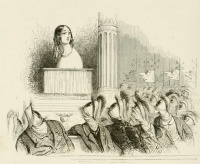
Look how solemn they are! from Los Caprichos by Francisco de Goya

Once again I am reminded of “To Every Man His Chimera,” one of the darkest prose poems of Charles Baudelaire.

The previous time Baudelaire’s unlucky men came to my recollection, trudging through the dust carrying upon their backs an enormous chimera as heavy as a sack of flour or coal, was while reading Joko’s Anniversary (perhaps my finest reading experience of 2013, along with the many Cortázar’s short stories I’ve had the pleasure to read).

This time the occasion is my recent acquisition of Goya : Caprichos, Desastres, Tauromaquia, Disparates (1982, Fundación Juan March), a complete set of all the engravings by Goya.

“Look how serious they are!” is number 63 from 80 prints of the Caprichos and it depicts “two demons taking a little exercise, and riding on grotesque beasts. One demon has the head of a bird, the other of a donkey.” The pack animals, the grotesque beasts, look like bipedal donkeys with faces half human, half donkey.

Creatures with the head of a bird are frightening. The wattle!, the comb!

The reverse motif, creatures with the feet of birds, has been employed in Un priape marchant sur des pattes de coq, with a far less frightening — yes, even ludicrous — effect.