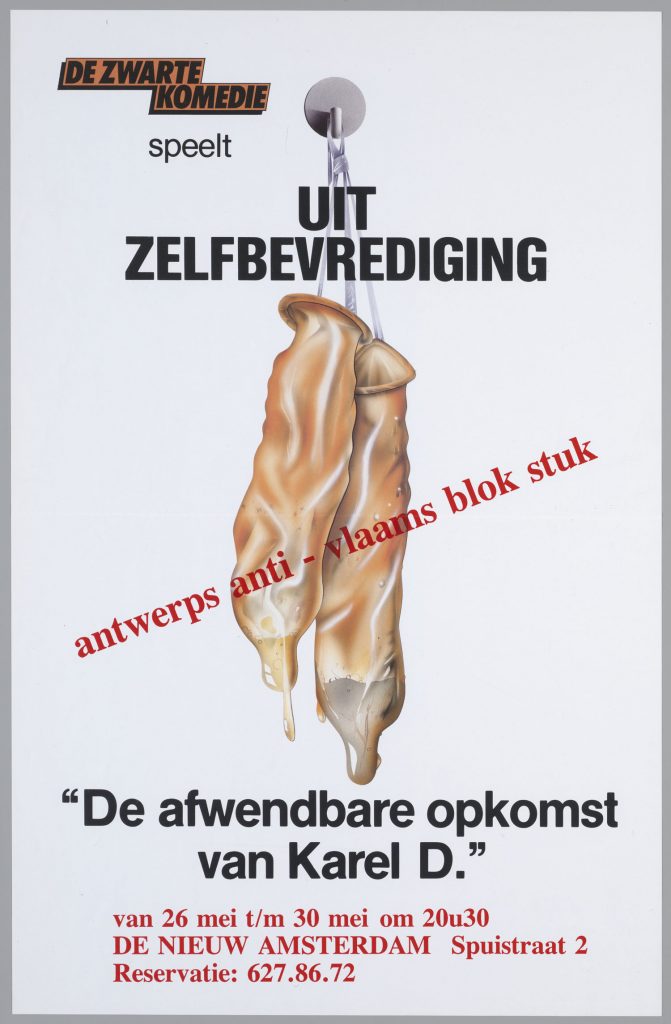
After almost 40 years of left wing mayors in Antwerp, right wing mayor Bart De Wever came to power and Verhoye’s theater De Zwarte Komedie lost its funding.
When I discovered Parliament-Funkadelic in the 1990s, part of the attraction was the visual style and the grand narrative holding the whole project together. This style was just as much due to George Clinton as to Pedro Bell.
A seminal text in his poetic oeuvre is from the sleeve notes of Standing on the Verge of Getting It On (1974):
“AS IT IS WRTTEN HENCEFORTH… On the Eighth Day, the Cosmic Strumpet of Mother Nature was spawned to envelope this Third Planet in FUNKADELICAL VIBRATIONS. And she birthed Apostles Ra, Hendrix, Stone, and CLINTON to preserve all funkiness of man unto eternity… But! Fraudulent forces of obnoxious JIVATION grew…only seedling GEORGE remained! As it came to be, he did indeed begat FUNKADELIC to restore Order Within the Universe. And nourished from the pamgrierian mammaristic melonpaps of Mother Nature, the followers of FUNKADELIA multiplied incessantly!”
Everyone knows Peter Fonda from the film Easy Rider (1969) a cult film which is so well-known that it is actually a mainstream film.
I saw the film somewhere in the 1990s but hardly remember anything about it. Given the choice — knowing what I know now — between watching Easy Rider and its predecessor The Wild Angels (1966) I’d watch the latter, being that it is as hilarious as it is historiographical (in the sense that Wild Angels tells us more about the sixties zeitgeist than Easy Rider, I refer specifically to the speech featuring “We wanna be free to ride our machines without being hassled by The Man!”)
But now Fonda is dead and despite the dictum “de mortuis nisi nihil bonum“, a few things need to be said before the praise can begin:
“[Peter Fonda] had nowhere near the talent of his father Henry Fonda or sister Jane Fonda, but he was popular with young audiences from the early sixties to early seventies because he was good-looking, knew how to ride a motorcycle, made “hip” pictures with drug-related themes, and, to hide his acting limitations, smartly played characters who were tight-lipped, unemotional, and often wore shades.” —Cult Movie Stars (1991) by Danny Peary
Now for the praise.
Upon the death of an actor or director, I check YouTube for films featuring the corpse in question. And so it happened that I stumbled upon The Hired Hand (1971). Never heard of it before. Started reading about it. Appeared to be a revisionist western. Interesting category. Started watching. Liked the music. The story is that of a man who is tired of drifting the Wild West and returns home to the wife and child he left seven years earlier. She accepts him, not as a husband, but as a hired hand.
That same Danny Peary who called Fonda not a good actor calls The Hired Hand a “feminist western”.
Why?
Because the film pays lots of attention to the abandoned woman and her sexual needs during the departure of her husband. A sort of Penelope vs. Odysseus.
On two occasions Hannah (the abandoned wife) ruminates about her lust for sex. These dialogues are extremely interesting and the second scene, in which Oates touches the ankle of Bloom, is actually quite sexy.
The first conversation of her sex life is with returned husband (Fonda) who has heard rumors in town of her sexual escapades [47:00]:
“You hired men to sleep with,” says he.
She responds:
“Sometimes I’d have him or he’d have me whatever suits you.”
And in a second scene she says to Arch Harris (Oates) [54:00]:
“You probably think I’m pretty hot … Well I am … don’t wannabe but I am … I don’t know how many nights I set on the porch … watching the shed … hoping whoever was in there would come out … hoping and terrified in case he did … wouldn’t really matter whether it was you or him tonight.”
In the course of my research following his death, I found that Belolo was co-responsible for a horrifying version of “Aquarela do Brasil” by the Ritchie Family, and for the kitsch classics “Y.M.C.A.”, “In the Navy”, and “Go West” by the Village People.
https://www.youtube.com/watch?v=N2HQJbpWT8w
However, it is Break Machine’s record “Street Dance” (1983) which I want to bring your attention here. A personal favorite, of however questionable taste it may appear to be.
Perhaps an offending passage is this one, in which Sethe pays the tombstone engraver with sex:
“You got ten minutes I’ll do it for free.
Ten minutes for seven letters. With another ten could she have gotten “Dearly” too? She had not thought to ask him and it bothered her still that it might have been possible–that for twenty minutes, a half hour, say, she could have had the whole thing, every word she heard the preacher say at the funeral (and all there was to say, surely) engraved on her baby’s headstone: Dearly Beloved.”
Margaret Atwood in Writing with Intent: Essays, Reviews, Personal Prose: 1983-2005 (2009) remarks:”Sethe wanted “Dearly Beloved [on the tombstone],” from the funeral service, but had only enough strength to pay for one word. Payment was ten minutes of sex with the tombstone engraver.”
D. A. Pennebaker was an American documentary filmmaker and one of the pioneers of direct cinema. Documentaries about performing artists and politics were his primary subjects. He was known for his hand-held camera aesthetic.
To the general audience, he is probably best-known for the film clip to “Subterranean Homesick Blues“, in which Dylan displays and discards a series of cue cards bearing selected words and phrases from the lyrics of the song.
A quick check found some really boring television (I love boring television if it’s extremely boring, regular television is just plain boring).
In the beginning of this bit two men in suits are sitting on a sofa facing each other as well as the camera. They are John Passmore and Bryan Magee and they discuss David Hume in 1987: