Jerry Herman was an American composer and lyricist, known for his work in Broadway musical theater. He composed the scores for the hit Broadway musicals Hello, Dolly!, Mame, and La Cage aux Folles. He was nominated for the Tony Award five times, and won twice, for Hello, Dolly! and La Cage aux Folles.
By pure coincidence I was watching Paris Is Burning (1990) this afternoon, it features the Jerry Herman-penned gay anthem “I Am What I Am” from La Cage Aux Folles.
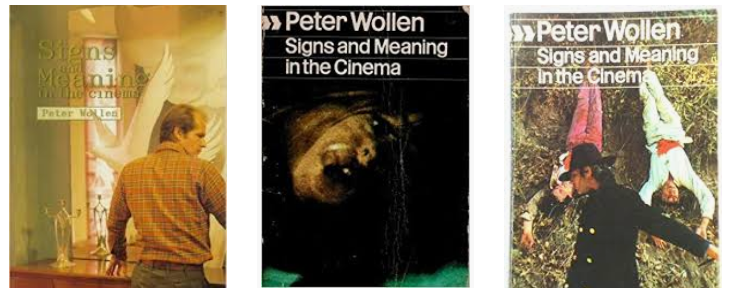
He is best-known for his book Signs and Meaning in the Cinema (1969) as well as his marriage to and collaboration with Laura “visual pleasure” Mulvey.
Wollen reads the U.S. Press: “People Magazine” and “Scientific American” in the same breath
Above is an enigmatic video from Paper Tiger Television in which Wollen “reads the U.S. Press: ‘People Magazine’ and ‘Scientific American’ in the Same Breath”.
Sometimes, the death of someone serves as a jumping board to something only tangentially related to the deceased. This is the case with the Yo Yo film fragment with its mime aesthetic in which Auger plays Isolina.
Nevertheless, please enjoy despite its tangentiality.
Two art icons of the Low Countries, the area where I live and where Dutch is spoken, died. One was an artist, the other a poet.
One is Panamarenko (1940 – 2019) and I reported his death here.
The other is the Dutch poet Jules Deelder (1944 – 2019).
When the second died I felt empathy, some sense of loss that I had not felt with the first.
And then it dawned on me why that was. To me, Panamarenko was but some sort of town’s fool who made art to amuse the rich or for the ‘poor little rich folk’ who were in search of their inner child and recognized in him their boy’s dream. Although I did not dislike him, my feelings toward him had been at best ambiguous.
Deelder was another case altogether.
I’d always liked him. He was punk. He was into drugs. He snorted speed. He looked stylish. He was into music. He made poetry cool. He made art for the rich and poor. He crossed boundaries. He was sharp. He was funny.
For an international audience, there are a set of four jazz compilations: ‘Deelder draait’ (2002), ‘Deelder draait door’ (2003), ‘Deelder blijft draaien’ (2004) and ‘Deelderhythm’ (2006).
Panamarenko was a Belgian artist famous for his cars that did not drive, his flying machines that did not fly and his submarines that did not submerge.
He was the archetypical artist, living with his mother in the Seefhoek until she died; a strange man who seemed out of place in the real world.
These four appearances were from television commercials. Three fragments are from a Monsavon commercial, a fourth I have been unable to identify.
In the first clip (13:53) Anna stands in front of a mirror in the same bathroom as in which she takes a bath in the third clip.
The voice-over: “What was directly lived reappears frozen in the distance, engraved in the tastes and illustions of an era and carried off with it.”
In the second clip (14:41) she is in the bath and rubs herself with soap.
The voice-over: “There is no more should-be; being has been consumed to the point of ceasing to exist. The details are already lost in the dust of time. “Who was afraid of life, afraid of the night, afraid of being taken, afraid of being kept?”
In the third clip (17:30) she is seen at the wheel of a convertible car, a bird’s eye view, three young people get out of the car.
The voice-over: “In the final analysis, stars are not created by their talent or lack of talent, or even by the film industry or advertising. They are created by the need we have for them.”
The fourth clip (18:09) begins where the first clip left off.
The voice-over: “The advertisements during intermissions are the truest reflection of an intermission from life.” Translations are from [1].
I was fourteen when this came out but only discovered this in my early twenties. In the garage rock period in the mid 1980s, when we were dressed rockabilly style.
Danny Aiello was an American actor, often characterized as a character actor.
https://www.youtube.com/watch?v=peVF9tSlfW4
The Stuff (1985), full film, Mr Aiello can be seen from 15:40 onwards.
Aiello played in The Stuff (1985) by Larry Cohen. In that film he is Mr. Vickers, a man who works for the FDA and approved ‘the stuff’. He is later eaten by his dog who was being fed ‘the stuff’ too. They were both addicted to ‘the stuff’.
The Stuff is a typical Cohen film, at once critical of society and sensationalist.
It belongs to a small category of Hollywood films with an anti-consumerist message. Another important film in that category is They Live (1988).
Perhaps these are the two only films in that category.