Danny Aiello was an American actor, often characterized as a character actor.
https://www.youtube.com/watch?v=peVF9tSlfW4
The Stuff (1985), full film, Mr Aiello can be seen from 15:40 onwards.
Aiello played in The Stuff (1985) by Larry Cohen. In that film he is Mr. Vickers, a man who works for the FDA and approved ‘the stuff’. He is later eaten by his dog who was being fed ‘the stuff’ too. They were both addicted to ‘the stuff’.
The Stuff is a typical Cohen film, at once critical of society and sensationalist.
It belongs to a small category of Hollywood films with an anti-consumerist message. Another important film in that category is They Live (1988).
Perhaps these are the two only films in that category.
I have nothing with that band. Perhaps it’s a generation thing, I was 24 when their song “The Look” came out, so too old to make any sort of impression.
To me it’s more pap than pop because, let us be honest, this was 1989 and instead of listening to “The Look”, you could have been listening to “French Kiss” by Lil’ Louis, “I’ll House You” by Jungle Brothers, “Work That Mutherfucker” by Steve Poindexter, “Sueño Latino” by Sueño Latino, “Pacific State” by 808 State, “Fight the Power” by Public Enemy, “Funky Cold Medina” by Tone Lōc or “Wicked Game” by Chris Isaak.
Furthermore, in 1989 there was also “Love Shack” by The B52’s which brought pap-ish joy without the bombast of Roxette. Both bands share their use of the guitar but Roxette sounds like American middle of the road arena rock.
And if you were into guilty pleasures, you could have been listening to “Me So Horny” by 2 Live Crew or “Pump Up the Jam” by Technotronic.
“The Look” was featured on Grand Theft Auto IV, on the Vice City FM† channel, at least half of the songs on that channel are better than Roxette’s.
A long time ago, I decided to do only appreciative criticism, but since this blog has evolved into a necrology, it seems fitting that I strive for completeness and thus ‘bash‘ Roxette.
On the other hand, as the video above shows, Roxette had lots of fun.
Life is a stage and each must play his part… so Roxette, enjoy your symptom.
Roger Cardinal was a English art scholar famous for originating the term “outsider art” in his book Outsider Art (1972). Outsider art coincides with the anti-psychiatry movement of the 1970s.
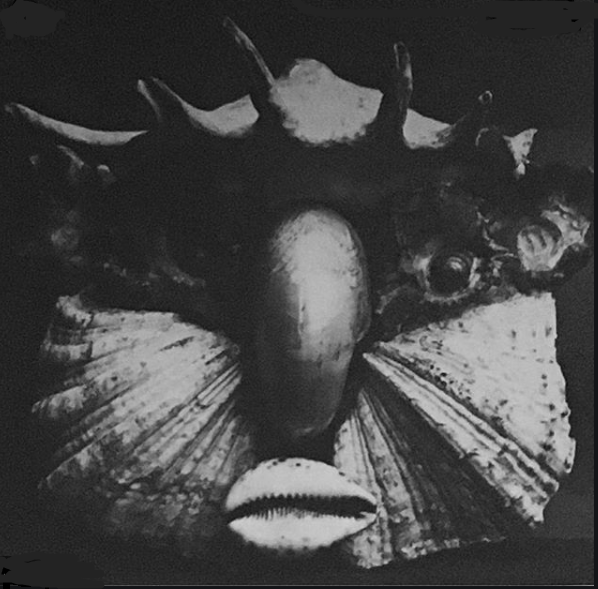
In that book, new to me was the work of Pascal-Désir Maisonneuve (1863 – 1934) who made work with seashells such as Mask of Queen Victoria (above), reminiscent of rocaille .
In that tradition is also Festoon, Masks and Rosettes Made of Shells (1656) by Jan van Kessel senior and Arcimboldesque Head and Beethoven Portrayed by Arcimboldo by Jan Švankmajer.
I’m interested in the era when traditional folk songs (which are per definition authorless) were appropriated by Western musicians and turned into pop hits.
This seems to also have been the case with the Belafonte songs Irving Burgie “wrote” .
Louise Bennett-Coverley gave Harry Belafonte the foundation for his 1956 hit “Day-O (The Banana Boat Song)” by telling him about the Jamaican folk song “Hill and Gully Rider” (the name also given as “Day Dah Light”).”
“Jamaica Farewell” was compiled and modified from many folk pieces to make a new song. Burgie acknowledged his use of the tune of another mento, “Iron Bar””.–Sholem Stein
I remember vividly how one night my parents went to a Harry Belafonte concert in Antwerp and lodged me and my brother in a fancy hotel which had a pool that was partly inside and partly outside the hotel. It was winter and the pool outside was steaming into the open air. This must have been before the first oil crisis. (update: I called my mother, it was the Sofitel, located on the Boomsesteenweg 15, Aartselaar)
Querying my database, I found out James also expressed his political views. As early as 1969 he contributed “Wind Up Black Dwarfs” – a plea for realpolitik – to London OZ.
I was unacquainted with the work of Wilson. Dave Letterman introduced him in the 1980s as the “guru of gruesome, wizard of the weird and the Michelangelo of the macabre.”
Me being European, Wilson reminds me of Tomi Ungerer (1931- 2019) or Roland Topor (1938-1997) and perhaps more of Topor, since like Topor, Wilson was not political.
Wilson’s appearance at David Letterman’s (March 30, 1982) when he published Is Nothing Sacred?.
Wilson is regarded as the only heir of Charles Addams (1912-1988) and often mentioned in one breath with Edward Gorey (1925-2000) .
The epithet ‘sick humor‘ sometimes pops up, although I have to disagree on this one, as, as a European, I am used to Hara Kiri, most likely the epitome of 20th century sick humor.
Since I found out about his death, I watched the “The Waitress” episode of The Kid (2001) and Wilson’s appearance at David Letterman’s (March 30, 1982) when he published Is Nothing Sacred?. I also listened to a reading of the wonderful story “The Sea was Wet as Wet Could Be” (1967).
His cartoon “I am an insane eye doctor and I am going to kill you now…” is frequently cited as of his best work. In it, a non-suspecting man reading an optometrist’s ‘eye examination’ with the text cited is approached from behind by a knife wielding optometrist.
There are body horror elements in his work and the cartoon “Harry, I really think you ought to go to the doctor.”, in which Harry is a regular man with the head of a prawn, is positively Lovecraftian.
These radicals came to my attention when I wrote a review of Whiteshift (2018) by Eric Kaufmann.
Googling for Noel Ignatiev does not bring up pages of left-wing political propaganda but pages of right-wing political propaganda. Of right wing white supremacists upset by what Ignatiev is saying.
Below is a transcript of a video of which you’ll find several copies on YouTube. It is a spliced video and I do not know where it was recorded nor who interviewed Ignatiev.
“My concern is doing away whiteness. Whiteness is a form of racial oppression, sure. The suggestion is that it is somehow possible to separate whiteness from oppression and it is not. There can be no white race without the phenomenon of white supremacy. If you abolish slavery you abolish slave holders. In the same way, if you abolish racial oppression you do away with whiteness, treason to whiteness is loyalty to humanity.” Interviewer: “Your views are fairly well received in academia” … “Yes the they are legitimate, not to say that everyone agrees but sure … I could not point to any examples where it has provoked political censorship … whiteness is an identity that arises entirely out of oppression … whiteness is not a culture … it’s not a religion, it’s not a language, it’s simply an oppressive social category …. Blackness is an identity that can be plausibly argued, black studies is a study of a people that has formed itself in resistance to its oppression. The task is to bring this minority together in such a way that it makes it impossible for the legacy of whiteness to continue to reproduce itself.”
I have not read books by Ignatiev but I do wonder how he would have gone about doing away with whiteness.
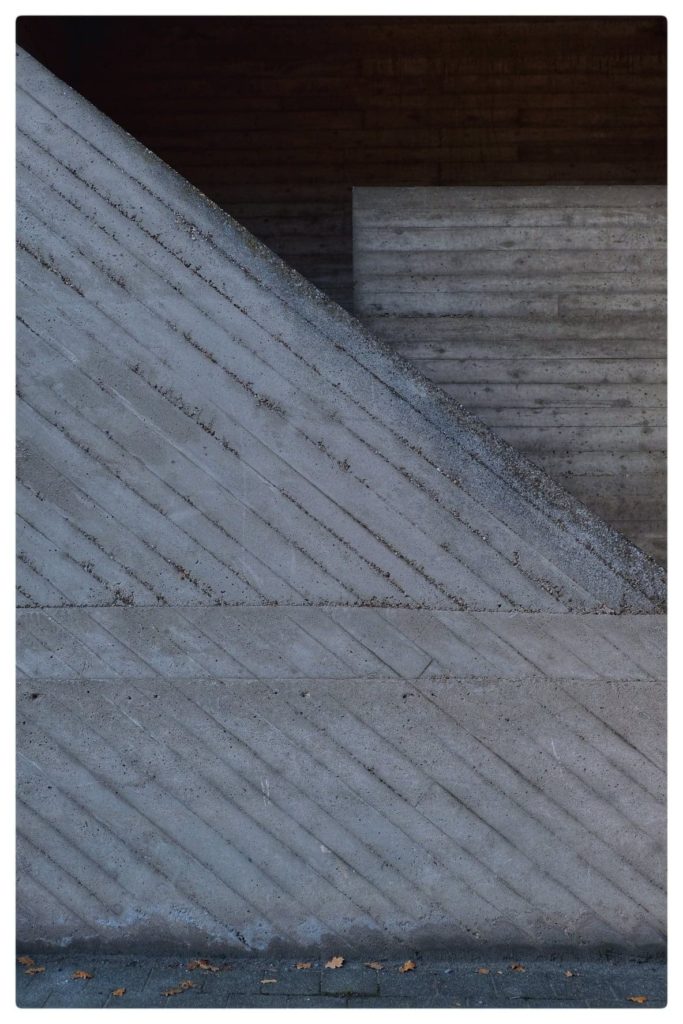
For lovers of the style, which includes myself, a big part of the attraction is that the imprint of the wood grain from the formwork of the concrete can be seen on the exterior concrete of brutalist structures.
Darondo was an American musician who released a couple of singles in the 1970s of which “Didn’t I” eventually became popular in the 2000s.
In view that his compositions never became hits, he was less than a one-hit wonder. However, the current upload of “Didn’t I”scored more than five million listens over the last five years.
Darondo’s voice has been described as a cross between Ronald Isley and Al Green.
Somehow his death did not appear on my radar back in 2013. These however: Junior Murvin, Lou Reed, JJ Cale, Bobby Bland, Ray Manzarek, Vincent Montana, Jr., Kevin Ayers, Donald Byrd and Cecil Womack, did.